 Help
Help
Written by Olena Lastivka
Olena is a nutrition and healthcare writer, runner, and gym enthusiast. She is keen on health and fitness research, modern studies on sports and nutrition, and various physical activities.

Fact checked by Dr. Olena Avdiievska, MD, RDN
Dr. Olena Avdiievska is a nutritional and medical expert at Unimeal. She is an MD and RDN in Dietology and nutrition and a university professor with 76 scientific publications.
Pear is a simple fruit that can easily become a part of your healthy diet. Read this article to discover how pear influences your health and find food ideas and cooking inspiration.
One average sweet pear contains 101 calories, most of which come from carbs. Pear is not the right choice to tame your hunger, but it still can be a nutritious snack, especially if you combine it with protein- and fat-rich foods.
Eat tasty food and lose weight with Unimeal app!
Take a Quiz – Get personal meal plan – Achieve your weight goals!
Start Quiz
Here's what you get from one medium pear1USDA Food Data Central. (2019, April 1). Pears, raw. U.S. Department of Agriculture. Agricultural Research Service. Retrieved from https://fdc.nal.usda.gov/fdc-app.html#/food-details/169118/nutrients:
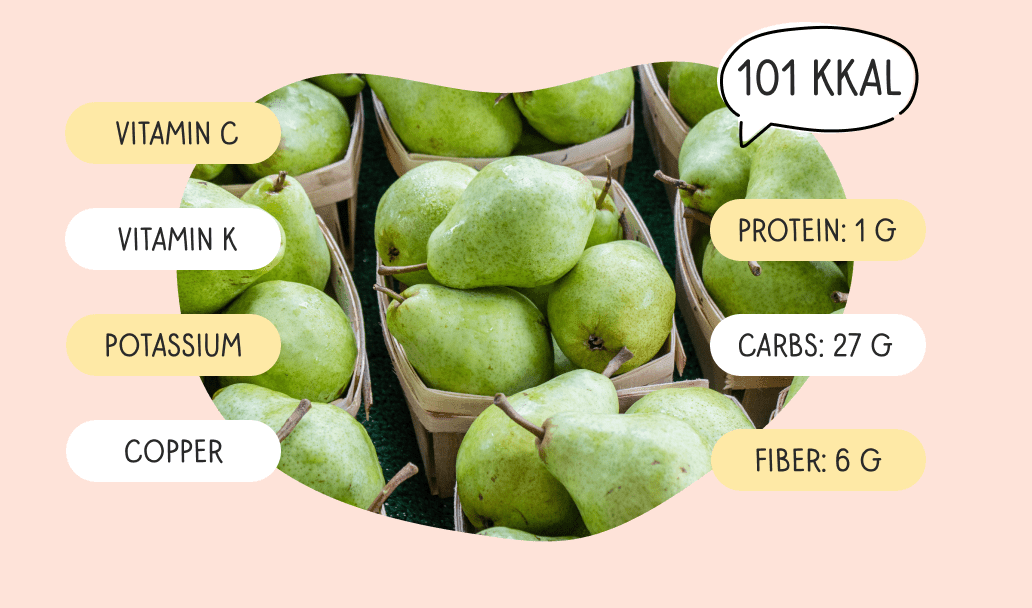
Pear is not as simple as it might seem at first glance. Take a look at the main pear benefits you can easily enjoy if you start eating pears regularly:
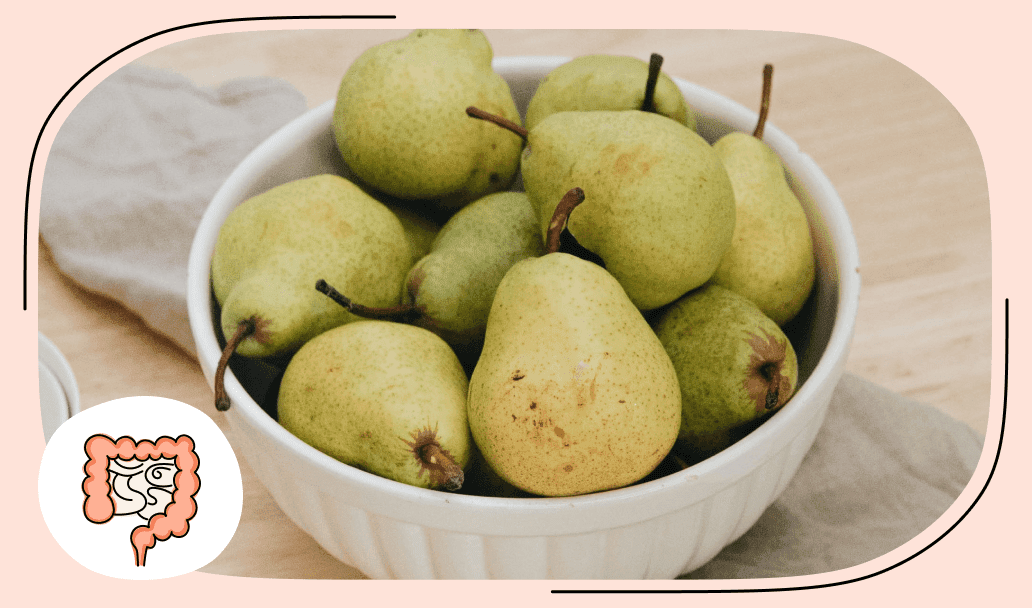
Pears contain dietary fiber and phytonutrients2Dreher M. L. (2018, November 28). Whole Fruits and Fruit Fiber Emerging Health Effects. Nutrients. DOI:10.3390/nu10121833. Soluble and insoluble fibers help to have regular stool without constipation3Xu, L., Yu, W., Jiang, J., & Li, N. (2014, December 30). Clinical benefits after soluble dietary fiber supplementation: a randomized clinical trial in adults with slow-transit constipation. Zhonghua yi xue za zhi. PMID:25623312 and have probiotic features2Dreher M. L. (2018, November 28). Whole Fruits and Fruit Fiber Emerging Health Effects. Nutrients. DOI:10.3390/nu10121833 that promote healthy bacteria4Slavin J. (2013, April 22). Fiber and Prebiotics: Mechanisms and Health Benefits. Nutrients. DOI:10.3390/nu5041417. Phytonutrients neutralize unhealthy bacteria and reduce the risk of food poisoning5Xia Li, TingtingWang, BinZhou, WenyuanGao, JingguoCao, LuqiHuang. (2013, December 11). Chemical composition and antioxidant and anti-inflammatory potential of peels and flesh from 10 different pear varieties. Food Chemistry. DOI:10.1016/j.foodchem.2013.12.010.
Pears are rich in vitamin C, which speeds up cell repair6Anitra C., Silvia Maggini. (2017). Vitamin C and Immune Function. Nutrients DOI:10.3390/nu9111211. You might have seen skincare products that contain vitamin C and have a higher price because of that. Good news: nourishing your body with vitamins from the inside is much cheaper and more effective than from the outside.
Pears are also lower in calories than other popular snacks such as sweets or nuts. Pears contain water and fiber, which makes them a satiating snack. They cannot relieve hunger for long as they mostly contain "fast" carbs, but they definitely do it better than chocolate.

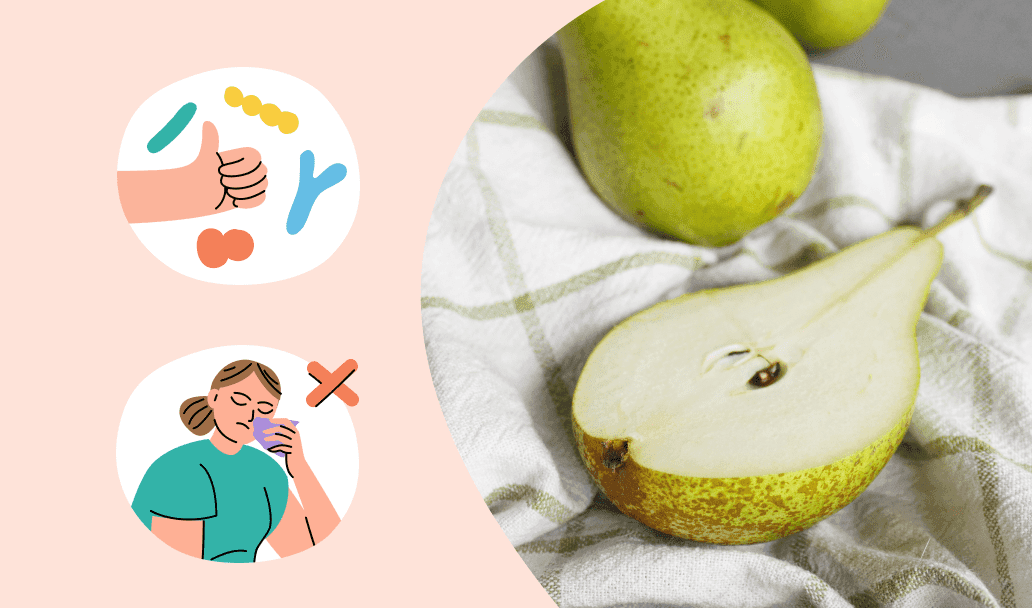
Pear has anti-inflammatory properties because they contain flavonoids and some other antioxidants5Xia Li, TingtingWang, BinZhou, WenyuanGao, JingguoCao, LuqiHuang. (2013, December 11). Chemical composition and antioxidant and anti-inflammatory potential of peels and flesh from 10 different pear varieties. Food Chemistry. DOI:10.1016/j.foodchem.2013.12.010. It makes your body's response to viruses and harmful bacteria stronger. The vitamins C and K also contribute to reducing the risk of inflammation7Harshman, S. G., & Shea, M. K. (2016, June 5). The Role of Vitamin K in Chronic Aging Diseases: Inflammation, Cardiovascular Disease, and Osteoarthritis. Current nutrition reports. DOI:10.1007/s13668-016-0162-x. Combined together, these components can also reduce the risk of cancer, diabetes, and heart disease because of their antioxidant properties5Xia Li, TingtingWang, BinZhou, WenyuanGao, JingguoCao, LuqiHuang. (2013, December 11). Chemical composition and antioxidant and anti-inflammatory potential of peels and flesh from 10 different pear varieties. Food Chemistry. DOI:10.1016/j.foodchem.2013.12.010.
As we have mentioned before, vitamin C helps your skin recover faster. Apart from fighting viruses and bacteria, quick skin recovery also means that you will get fewer wrinkles and age spots, post-acne scars, and other imperfections. Dietary fiber saves collagen cells from falling apart and keeps them moisturized8Proksch E.,Schunck M., Zague V., Segger D., Degwert J., Oesser S. (2014, February). Oral Intake of Specific Bioactive Collagen Peptides Reduces Skin Wrinkles and Increases Dermal Matrix Synthesis. Skin Pharmacology and Physiology. DOI:10.1159/000355523.
You can also experiment with pears: use pear puree as a face mask or as a component for hydrogel patches.

Pears are always available at supermarkets. We recommend eating them more frequently during autumn and winter when they retain most vitamins and minerals.
You can eat fresh pears to get most of their health benefits. Just make sure they are ripe. Pears get ripe at room temperature, surrounded by sun. Dried pears are also a good snack; you can easily carry them anywhere you want. Pear puree is another variation of eating pears that can be a separate dish or a sauce.
Roast pears to make them sweeter and creamier in texture. Then you can serve it with a dessert or decorate it with nuts. Such pears are also a good complement to chicken, duck, or pork as they enhance the meat's taste.
You can also buy some pear pastille if you want to try something new. Pear jam is also delicious but not as healthy because it contains significantly more sugar.
Pears won't be extra in almost any recipe that contains fruits. Here are the dishes you can put pears in:

If you are still wondering if you need to include pears in your diet, let's recap their main benefits once again:
And they are just tasty!
Unimeal does not diagnose or suggest treatments. Any description of the diet, training plan or supplement should be discussed with your current physician or nutritionist. This article does not address specific conditions and is simply meant to provide general information on healthcare topics. Following any advice is at your own initiative and does not impose any responsibility on the blog authors for your health and safety.
Sources:
By choosing high-quality sources, we make sure that all articles on the Unimeal blog are reliable and trustworthy. Learn more about our editorial processes.
1.
2.
3.
4.
5.
6.
7.
8.
Related Articles